
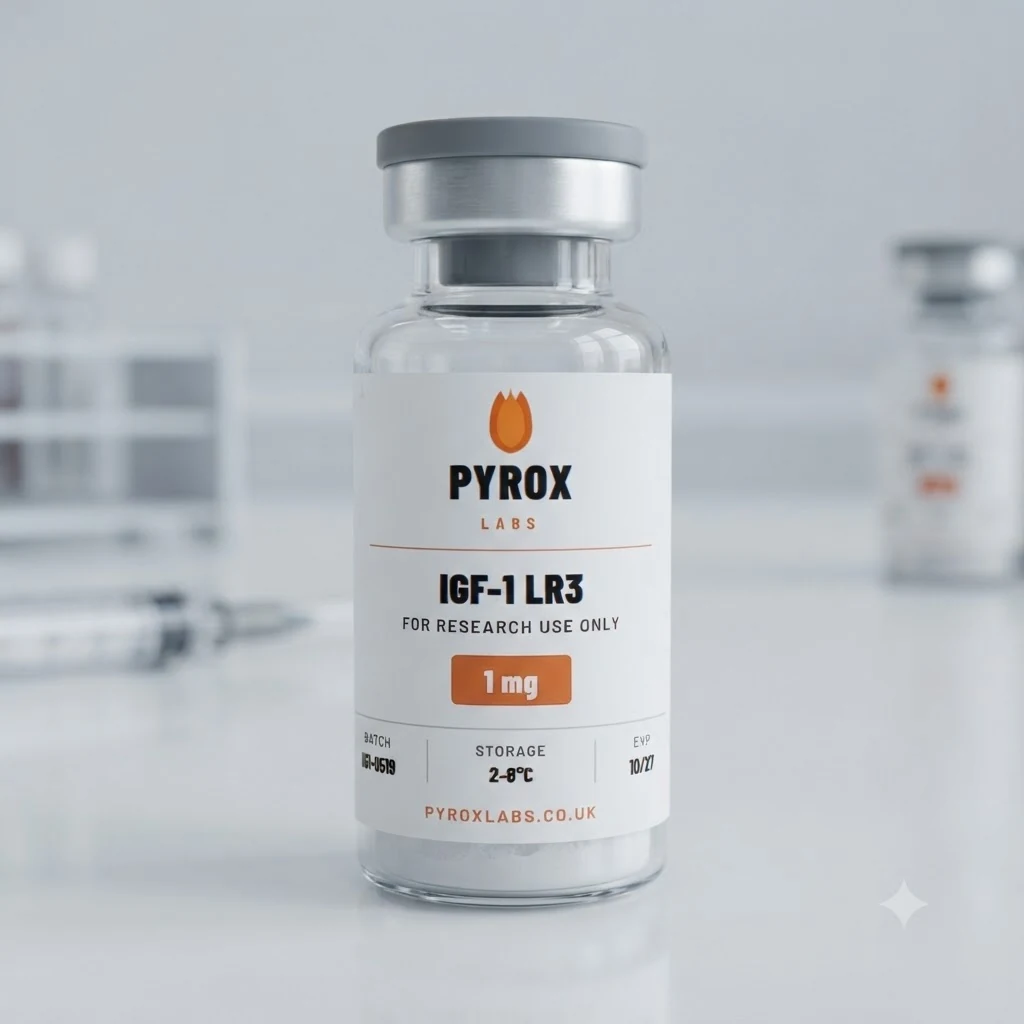
This IGF-1 LR3 Research Guide is part of the Pyrox Labs Knowledge Hub — for laboratory and research use only. Not for human or veterinary use.
WHAT IS IGF-1 LR3?
IGF-1 LR3 (Long R3 IGF-1) is a synthetic, engineered analogue of human Insulin-like Growth Factor 1 — not IGF-1 itself. It was originally developed as a cell-culture reagent (at GroPep Ltd., Australia), not as a clinical drug candidate, and that remains its primary role in published research today. Structural modifications — 13 additional N-terminal amino acids plus a substitution at position 3 — sharply reduce its affinity for IGF-binding proteins (IGFBPs), which normally sequester native IGF-1 in circulation and in culture media. This guide summarises the published preclinical and in-vitro literature on IGF-1 LR3 for laboratory researchers.
RESEARCH BACKGROUND
Published literature — see this PubMed literature search — has explored areas including:
- In vitro receptor-binding and cell-signalling pharmacology, where reduced IGFBP affinity makes IGF-1 LR3 a preferred laboratory reagent for isolating IGF-1 receptor (IGF-1R) activity from binding-protein confounding
- Rodent studies of skeletal muscle protein turnover and hypertrophy-related signalling
- Tumour-bearing animal models, where at least one published study found IGF-1 LR3 promoted muscle protein turnover but also increased tumour growth — an important finding for researchers to be aware of
- Broader IGF-1R signalling research: the PI3K/Akt/mTORC1 pathway (protein synthesis) and MAPK/ERK pathway (proliferation/differentiation)
Important for researchers: no published Phase 1, 2, or 3 human clinical trial of IGF-1 LR3 exists in the literature. It has never advanced into human drug development. Any claims about its effects in humans should be treated as unsupported by current published evidence.
PROPOSED MECHANISM OF ACTION
IGF-1 LR3 acts as an agonist at the IGF-1 receptor (IGF-1R), a receptor tyrosine kinase, activating the same PI3K/Akt/mTORC1 and MAPK/ERK signalling arms studied for native IGF-1. Its defining research property is reduced binding to IGFBPs, which increases the free, bioavailable fraction available to interact with IGF-1R — approximately 1.5–2x greater biological potency than native IGF-1 in some in-vitro assays. This same property is responsible for a common point of confusion: some secondary sources describe IGF-1 LR3 as having a very long biological half-life, but the peer-reviewed animal literature indicates it is actually cleared faster than native IGF-1 in vivo, precisely because it cannot bind the protective IGFBP-3 complex. Its genuine, well-documented advantage is in-vitro stability — persisting for hours in cell-culture media at 37°C versus tens of minutes for native IGF-1 — which is why it is valued as a laboratory reagent.
HANDLING & STORAGE
- Store lyophilised IGF-1 LR3 vials in a freezer (-20°C), protected from light, for long-term storage.
- Once reconstituted, store refrigerated (2–8°C) and use within the timeframe indicated by your research protocol; aliquoting before freezing is recommended to avoid repeated freeze-thaw cycles.
- Use sterile technique and appropriate PPE when handling.
- See our Reconstitution Guide for general laboratory reconstitution reference information.
CERTIFICATES OF ANALYSIS
Independently tested for purity and identity. Search by product name and the batch/lot number printed on your vial label.
FREQUENTLY ASKED QUESTIONS
Is IGF-1 LR3 approved for human use?
No. IGF-1 LR3 products sold by Pyrox Labs are not approved by any regulatory authority for human or veterinary use, and no human clinical trial data exists for this compound. It is sold strictly for laboratory and research purposes.
Can Pyrox Labs advise on dosing or administration?
No. We do not provide dosing, administration, or treatment guidance of any kind. Our team can only answer questions relating to order status, product specifications, and COA/testing documentation.
Does IGF-1 LR3 have a long half-life in the body?
This is a commonly repeated claim that isn’t well supported by the peer-reviewed animal literature. Published data suggests it is actually cleared relatively quickly in vivo; its documented advantage is stability in cell-culture conditions, not a prolonged in-vivo half-life.
How is IGF-1 LR3 supplied for laboratory research?
Pyrox Labs supplies IGF-1 LR3 as a lyophilised (freeze-dried) powder in a sealed research vial, accompanied by a Certificate of Analysis confirming purity and identity.
Research Use Disclaimer: IGF-1 LR3 products sold by Pyrox Labs are intended solely for in-vitro laboratory research and are not for human consumption, veterinary use, or any form of personal use. By purchasing, you confirm you are a qualified researcher or institution and agree to our full Research Use Disclaimer and Terms & Conditions.
Related: What Are Peptides · Reconstitution Guide · Peptide Glossary · COA Hub