
Knowledge Hub · Peptide Guide
NAD+ Research Guide
This NAD+ Research Guide is part of the Pyrox Labs Knowledge Hub — for laboratory and research use only. Not for human or veterinary use.
Research use only. NAD+ is not approved by the FDA, MHRA, or any regulatory body for human or animal use. All information below is a summary of published research literature, provided for educational purposes only.
What Is NAD+?
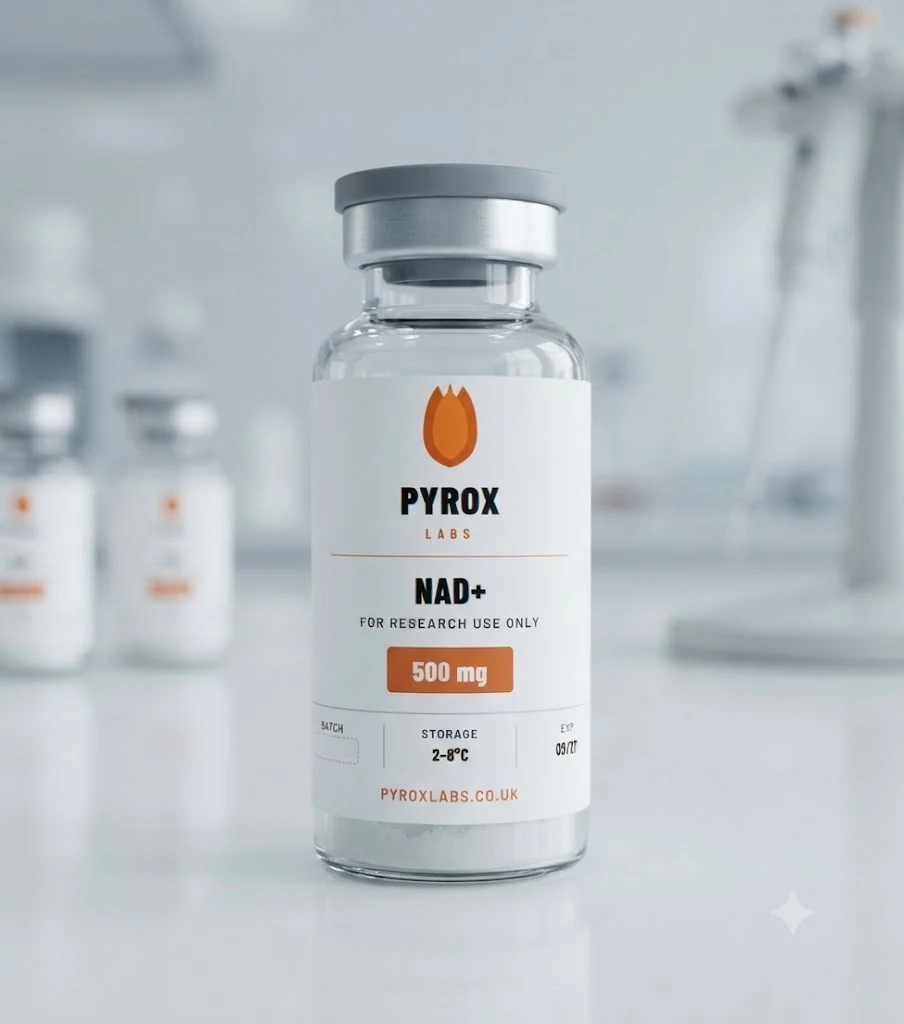
Nicotinamide adenine dinucleotide (NAD+) is a coenzyme found in all living cells, playing a central role in cellular metabolism and energy production. In research settings, NAD+ is studied as a compound relevant to cellular ageing, mitochondrial function, and metabolic pathways. It is supplied for laboratory and research use only. This NAD+ Research Guide summarises the published literature on NAD+ for laboratory researchers. As one of the most abundant coenzymes in mammalian cells, NAD+ has become a central focus of cellular ageing and longevity science over the past two decades, with researchers studying how intracellular NAD+ concentration changes across preclinical models.
Research Background
NAD+ has been the subject of extensive preclinical and cell-culture research. Published literature — see this PubMed literature search — has explored areas including:
- Cellular energy metabolism and mitochondrial function
- Sirtuin pathway activity and cellular ageing models
- DNA repair mechanisms (PARP enzyme activity)
- Metabolic research models, including studies on cellular stress response
- Neuroscience research relating to cellular ageing pathways
- Age-related decline in intracellular NAD+ concentration, a widely cited area of longevity science
Proposed Mechanism of Action
NAD+ functions as a coenzyme in redox reactions, shuttling electrons in metabolic pathways such as glycolysis and the citric acid cycle. Researchers have also studied its role as a substrate for sirtuins and PARP enzymes, both implicated in cellular repair and ageing pathways. These mechanisms remain an active area of scientific investigation. Because NAD+ levels decline naturally with age in preclinical models, restoring intracellular NAD+ concentration is a widely studied strategy across ageing-related laboratory research programmes.
NAD+ Research Guide — Handling & Storage
- Store lyophilised NAD+ vials in a freezer (-20°C) for long-term storage, protected from light, as the compound is light- and temperature-sensitive.
- Once reconstituted, store refrigerated (2–8°C) and use within the timeframe indicated by your research protocol, as reconstituted NAD+ can degrade more quickly than other peptides.
- Use sterile technique and appropriate PPE when handling.
- See our Reconstitution Guide for general laboratory reconstitution reference information.
Certificates of Analysis
Independently tested for purity and identity. Search by product name and the batch/lot number printed on your vial label.
View COA HubFrequently Asked Questions
Is NAD+ approved for human use?
No. NAD+ products sold by Pyrox Labs are not approved by any regulatory authority for human or veterinary use. They are sold strictly for laboratory and research purposes.
Can Pyrox Labs advise on dosing or administration?
No. We do not provide dosing, administration, or treatment guidance of any kind. Our team can only answer questions relating to order status, product specifications, and COA/testing documentation.
Why is NAD+ more sensitive to storage conditions than other compounds?
NAD+ is prone to degradation from light, heat, and repeated freeze-thaw cycles. Researchers should follow strict cold-chain and light-protection protocols to preserve sample integrity.
How is NAD+ supplied for laboratory research?
Pyrox Labs supplies NAD+ as a lyophilised (freeze-dried) powder in sealed research vials, with each batch accompanied by a Certificate of Analysis confirming purity and identity.
Research Use Disclaimer: NAD+ products sold by Pyrox Labs are intended solely for in-vitro laboratory research and are not for human consumption, veterinary use, or any form of personal use. By purchasing, you confirm you are a qualified researcher or institution and agree to our full Research Use Disclaimer and Terms & Conditions.