
SM1 (Semaglutide) is a GLP-1 receptor agonist widely used in metabolic and appetite-regulation research. Because it’s supplied as a lyophilised (freeze-dried) powder, it must be reconstituted with bacteriostatic water before it can be used in solution. This guide covers the full reconstitution process for SM1 5mg, 10mg and 20mg vials, with worked dilution examples for each.
Research Use Only: This guide is intended strictly for laboratory research purposes. SM1 (Semaglutide) is not approved for human or animal consumption, and nothing in this article should be interpreted as medical, dosing, or usage advice.
What You’ll Need
- A vial of lyophilised SM1 (5mg, 10mg or 20mg)
- Bacteriostatic water (0.9% benzyl alcohol)
- Alcohol swabs
- A sterile reconstitution syringe (5ml, 21G is ideal for adding water)
- A clean, flat work surface
Step-by-Step: Reconstituting SM1
- Prepare your environment. Work on a clean, flat surface and wash your hands before handling any vials.
- Calculate your dilution volume. Decide how much bacteriostatic water to add based on the concentration required for your research (see worked examples below).
- Swab both vial tops. Wipe the rubber stopper of both the SM1 vial and the bacteriostatic water vial with a fresh alcohol swab and let them air dry.
- Draw the bacteriostatic water. Using your syringe, draw the calculated volume of bacteriostatic water.
- Add the water to the peptide vial slowly. Insert the needle at an angle and let the water run down the inside wall of the glass — never spray it directly onto the powder.
- Dissolve gently. Swirl or gently roll the vial between your palms until fully dissolved. Do not shake.
- Inspect the solution. Properly reconstituted SM1 should be clear and colourless with no visible particles.
- Label and store immediately. Write the date and concentration on the vial and refrigerate straight away.
Worked Dilution Examples
A common approach is to add 2ml of bacteriostatic water regardless of vial strength, which keeps the maths simple:
- SM1 5mg + 2ml BAC water = 2,500mcg/ml (2.5mg/ml)
- SM1 10mg + 2ml BAC water = 5,000mcg/ml (5mg/ml)
- SM1 20mg + 2ml BAC water = 10,000mcg/ml (10mg/ml)
On a standard U-100 insulin syringe, 1 IU (0.01ml) corresponds to 1% of the total vial concentration — so at 5,000mcg/ml, 1 IU delivers roughly 50mcg. Use our Research Dilution Calculator to work out the exact figures for any vial strength and water volume.
Storage & Stability
- Lyophilised (unreconstituted) SM1 is stable at room temperature, protected from light, generally for 12–24 months.
- Reconstituted SM1 should be refrigerated at 2–8°C at all times and never frozen.
- Use reconstituted solution within 28 days for best integrity.
Common Mistakes to Avoid
- Shaking the vial instead of gently swirling it
- Using plain sterile or bacteriostatic-free water for a multi-use vial
- Spraying water directly onto the powder rather than down the glass wall
- Leaving reconstituted solution unrefrigerated or freezing it
- Miscalculating concentration when switching between vial strengths
FAQ
Does the water volume have to be exactly 2ml? No — 2ml is simply a common reference point because it produces round numbers. Any volume can be used; recalculate the resulting concentration accordingly.
Why is my SM1 solution cloudy? Slight cloudiness usually clears with continued gentle swirling. Persistent cloudiness or particulate matter means the vial should not be used.
Can I mix different vial strengths together? Each vial should be reconstituted and tracked separately to keep concentration calculations accurate and traceable.
Every SM1 vial from Pyrox Labs ships with a Certificate of Analysis confirming purity. Browse our SM1 research vials or read the full Reconstitution Guide for more detail and our interactive dilution calculator.
SM1 Reconstitution: Quick Reference
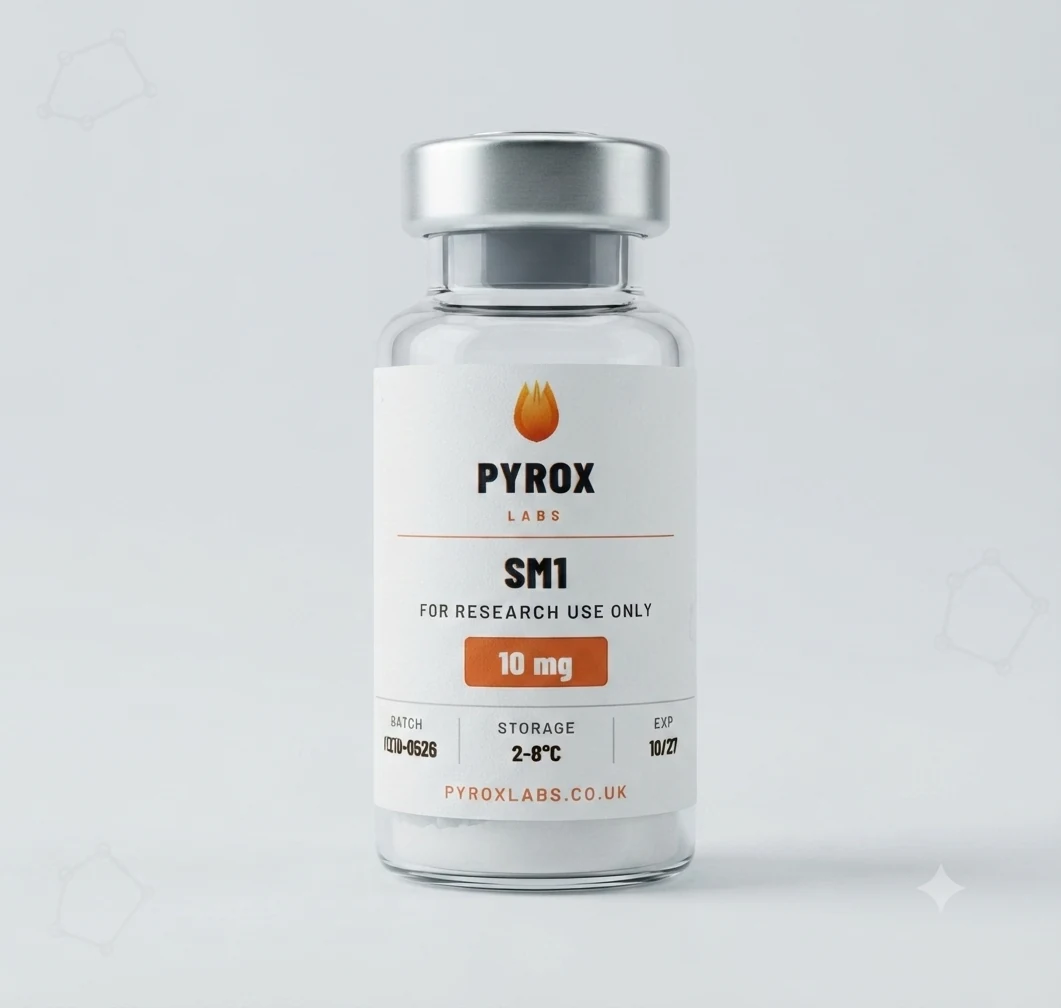
Keep this page bookmarked as a quick reference: always use bacteriostatic water (never plain sterile water) for SM1, inject slowly down the inside wall of the vial to avoid disturbing the lyophilised powder, and store the reconstituted solution refrigerated. For the full step-by-step method with worked dilution examples, see the sections above.
SM1 reconstitution: Common Mistakes to Avoid
The most frequent error in SM1 reconstitution is using plain sterile or distilled water instead of bacteriostatic water; the benzyl alcohol preservative in bacteriostatic water is what allows the reconstituted vial to be used safely over multiple days rather than once. Getting SM1 reconstitution wrong at this step is the single biggest cause of degraded results reported by researchers. For further independent background reading, see this peer-reviewed peptide stability research on PubMed Central.
To summarise correct SM1 reconstitution technique: work in a clean area, use bacteriostatic water only, add it slowly down the inside wall of the vial, and never shake the vial once SM1 reconstitution is complete.