
GHK-Cu (Copper Peptide) is a widely studied tripeptide used in skin, wound-healing and tissue-repair research. Like other lyophilised research compounds, it needs to be correctly reconstituted with bacteriostatic water before use in solution. This guide covers the full process for GHK-Cu 50mg vials, with a worked dilution example and storage guidance.
Research Use Only: This guide is intended strictly for laboratory research purposes. GHK-Cu is not approved for human or animal consumption, and nothing in this article should be interpreted as medical, dosing, or usage advice.
What You’ll Need
- A vial of lyophilised GHK-Cu 50mg
- Bacteriostatic water (0.9% benzyl alcohol)
- Alcohol swabs
- A sterile reconstitution syringe (5ml, 21G is ideal for adding water)
- A clean, flat work surface
Step-by-Step: Reconstituting GHK-Cu
- Prepare your environment. Work on a clean, flat surface and wash your hands before handling any vials.
- Calculate your dilution volume. Decide how much bacteriostatic water to add based on the concentration required for your research (see worked example below).
- Swab both vial tops. Wipe the rubber stopper of both the GHK-Cu vial and the bacteriostatic water vial with a fresh alcohol swab and let them air dry.
- Draw the bacteriostatic water. Using your syringe, draw the calculated volume of bacteriostatic water.
- Add the water to the peptide vial slowly. Insert the needle at an angle and let the water run down the inside wall of the glass — never spray it directly onto the powder.
- Dissolve gently. Swirl or gently roll the vial between your palms until fully dissolved. Do not shake.
- Inspect the solution. Properly reconstituted GHK-Cu typically has a pale blue tint (from the copper complex) and should be free of particles or cloudiness.
- Label and store immediately. Write the date and concentration on the vial and refrigerate straight away.
Worked Example: 50mg Vial
Pyrox Labs GHK-Cu vials are supplied at 50mg of lyophilised peptide. A common research dilution is to add 5ml of bacteriostatic water:
- 50mg ÷ 5ml = 10,000mcg/ml (10mg/ml)
- On a standard U-100 insulin syringe, 1 IU (0.01ml) of this solution equals approximately 100mcg
Adding more bacteriostatic water produces a more dilute solution; adding less produces a more concentrated one. Use our Research Dilution Calculator to work out the exact concentration for any vial strength and water volume combination.
Storage & Stability
- Lyophilised (unreconstituted) GHK-Cu is stable at room temperature, protected from light, generally for 12–24 months.
- Reconstituted GHK-Cu should be refrigerated at 2–8°C at all times and never frozen.
- Use reconstituted solution within 28 days for best integrity.
Common Mistakes to Avoid
- Shaking the vial instead of gently swirling it
- Using plain sterile or bacteriostatic-free water for a multi-use vial
- Spraying water directly onto the powder rather than down the glass wall
- Leaving reconstituted solution unrefrigerated or freezing it
- Mistaking the solution’s natural pale blue tint for contamination
FAQ
Is it normal for GHK-Cu solution to have a blue tint? Yes — the copper complex naturally gives reconstituted GHK-Cu a light blue colour. This is expected and is not a sign of contamination.
Why won’t my GHK-Cu dissolve fully? Slight cloudiness usually clears with continued gentle swirling. If particles remain after a few minutes, the vial should not be used.
Can I use a different water volume than 5ml? Yes — 5ml is simply a convenient reference point. Any volume can be used; recalculate the resulting concentration accordingly.
Every GHK-Cu vial from Pyrox Labs ships with a Certificate of Analysis confirming purity. Browse our GHK-Cu research vials or read the full Reconstitution Guide for more detail and our interactive dilution calculator.
GHK-Cu Reconstitution: Quick Reference
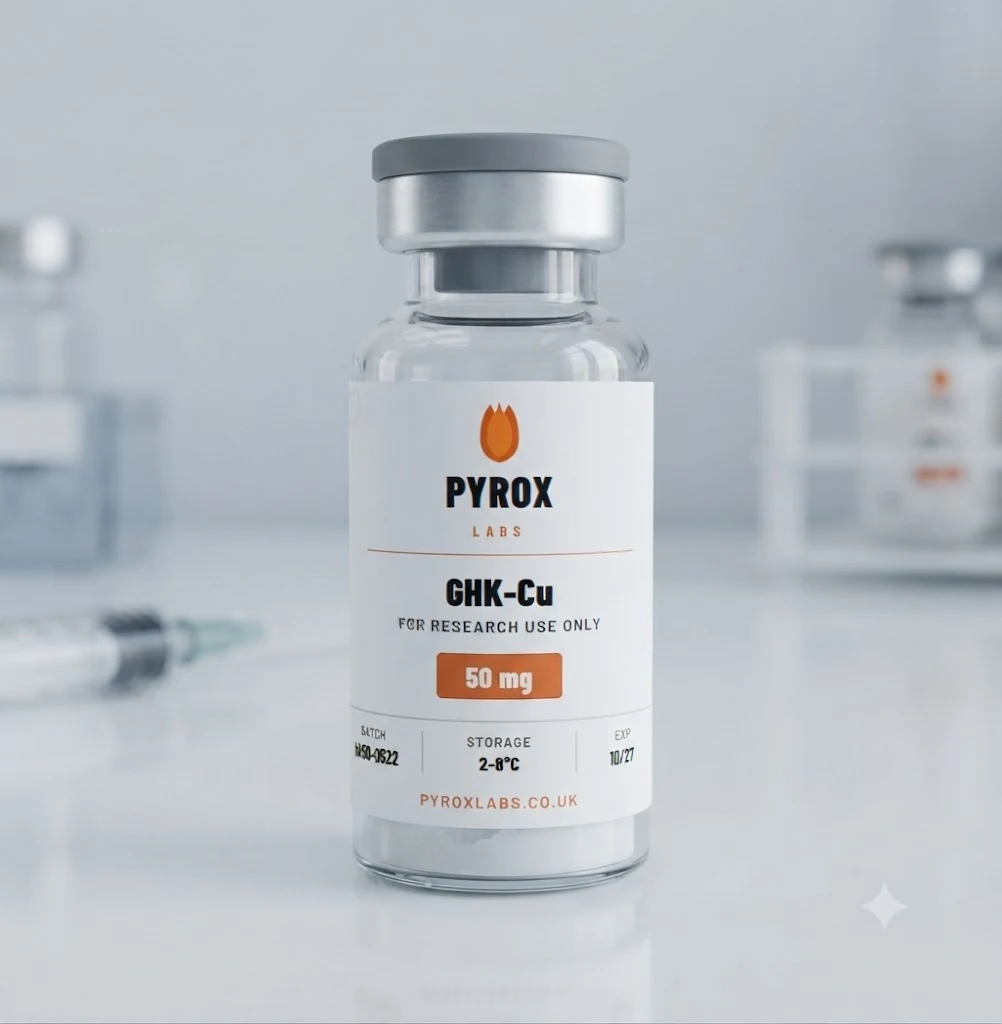
Keep this page bookmarked as a quick reference: always use bacteriostatic water (never plain sterile water) for GHK-Cu, inject slowly down the inside wall of the vial to avoid disturbing the lyophilised powder, and store the reconstituted solution refrigerated. For the full step-by-step method with worked dilution examples, see the sections above.
GHK-Cu reconstitution: Common Mistakes to Avoid
The most frequent error in GHK-Cu reconstitution is using plain sterile or distilled water instead of bacteriostatic water; the benzyl alcohol preservative in bacteriostatic water is what allows the reconstituted vial to be used safely over multiple days rather than once. Getting GHK-Cu reconstitution wrong at this step is the single biggest cause of degraded results reported by researchers. For further independent background reading, see this peer-reviewed peptide stability research on PubMed Central.
To summarise correct GHK-Cu reconstitution technique: work in a clean area, use bacteriostatic water only, add it slowly down the inside wall of the vial, and never shake the vial once GHK-Cu reconstitution is complete.