
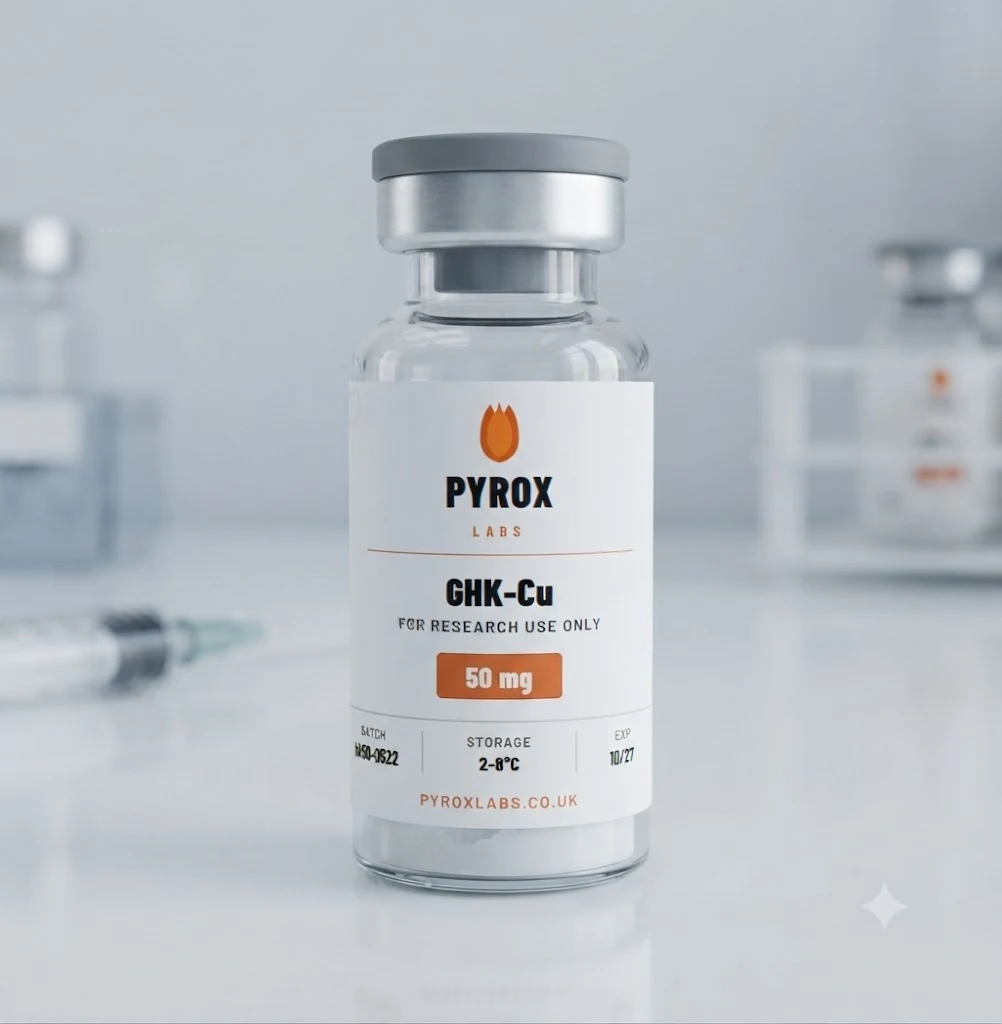
This GHK-Cu Research Guide is part of the Pyrox Labs Knowledge Hub — for laboratory and research use only. Not for human or veterinary use.
WHAT IS GHK-Cu?
GHK-Cu (Glycyl-L-Histidyl-L-Lysine-Copper) is a naturally occurring copper-binding tripeptide complex, first identified in human plasma. Rather than acting through a single receptor, GHK-Cu is studied for its broad effects on gene expression and extracellular matrix remodelling — it has been linked in transcriptomic research to the regulation of a very large number of human genes tied to tissue repair and antioxidant defence. It is one of the most established compounds in skin and wound-healing research. This guide summarises the published literature on GHK-Cu for laboratory researchers. If you need reconstitution steps specifically, see our dedicated GHK-Cu Reconstitution Guide.
RESEARCH BACKGROUND
Published literature — see this PubMed literature search — has explored areas including:
- Extracellular matrix remodelling: collagen, dermatan sulfate, chondroitin sulfate and decorin synthesis
- Dermatology and anti-photoaging research (the strongest published human trial evidence, largely topical formulations)
- Hair follicle research, including comparative work against topical minoxidil in vitro/animal models
- Wound healing across multiple tissue types (skin, gastrointestinal, bone, and footpad models)
- Anti-inflammatory and antioxidant pathway research (modulation of TNF-alpha, IL-6, and TGF-beta1)
PROPOSED MECHANISM OF ACTION
The GHK tripeptide forms a high-affinity complex with Cu²⁺, facilitating copper transport into and out of cells. This complex is studied for its role in modulating metalloproteinase activity and their inhibitors, supporting a balance between tissue breakdown and repair, alongside anti-inflammatory and antioxidant activity. Gene-expression microarray studies have found GHK-Cu associated with changes in expression across a broad range of genes tied to tissue regeneration, DNA repair enzymes, and antioxidant defence systems. A substantial portion of this transcriptomic and mechanistic research base originates from one research group (Pickart and colleagues) — a point worth noting when weighing the overall evidence base, alongside the separately published clinical topical trial data from other research teams.
GHK-Cu RESEARCH GUIDE — HANDLING & STORAGE
GHK-Cu is notably less stable in solution than many other research peptides — degradation is driven primarily by copper-catalysed peptide bond hydrolysis rather than oxidation, and is accelerated by light exposure.
- Store lyophilised GHK-Cu at room temperature, protected from light; for longer-term storage, a freezer (-20°C) is preferable.
- Once reconstituted, store refrigerated (2–8°C) and away from light — reconstituted solution can lose potency within 72 hours to two weeks depending on storage conditions.
- Use sterile technique and appropriate PPE when handling.
- See our full Reconstitution Guide and dilution calculator for step-by-step guidance specific to GHK-Cu.
CERTIFICATES OF ANALYSIS
Independently tested for purity and identity. Search by product name and the batch/lot number printed on your vial label.
FREQUENTLY ASKED QUESTIONS
Is GHK-Cu approved for human use?
No. GHK-Cu products sold by Pyrox Labs are not approved by any regulatory authority for human or veterinary use. They are sold strictly for laboratory and research purposes.
Can Pyrox Labs advise on dosing or administration?
No. We do not provide dosing, administration, or treatment guidance of any kind. Our team can only answer questions relating to order status, product specifications, and COA/testing documentation.
Why does reconstituted GHK-Cu have a blue tint?
The copper complex naturally gives reconstituted GHK-Cu solution a pale blue colour. This is expected and is not, on its own, a sign of contamination — see our Reconstitution Guide for a full breakdown of what to look for.
How is GHK-Cu supplied for laboratory research?
Pyrox Labs supplies GHK-Cu as a lyophilised (freeze-dried) powder in sealed research vials, with each batch accompanied by a Certificate of Analysis confirming purity and identity. GHK-Cu is also available as part of our GLOW 70 combination blend.
Research Use Disclaimer: GHK-Cu products sold by Pyrox Labs are intended solely for in-vitro laboratory research and are not for human consumption, veterinary use, or any form of personal use. By purchasing, you confirm you are a qualified researcher or institution and agree to our full Research Use Disclaimer and Terms & Conditions.
Related: GHK-Cu Reconstitution Guide · What Are Peptides · Peptide Glossary · COA Hub