
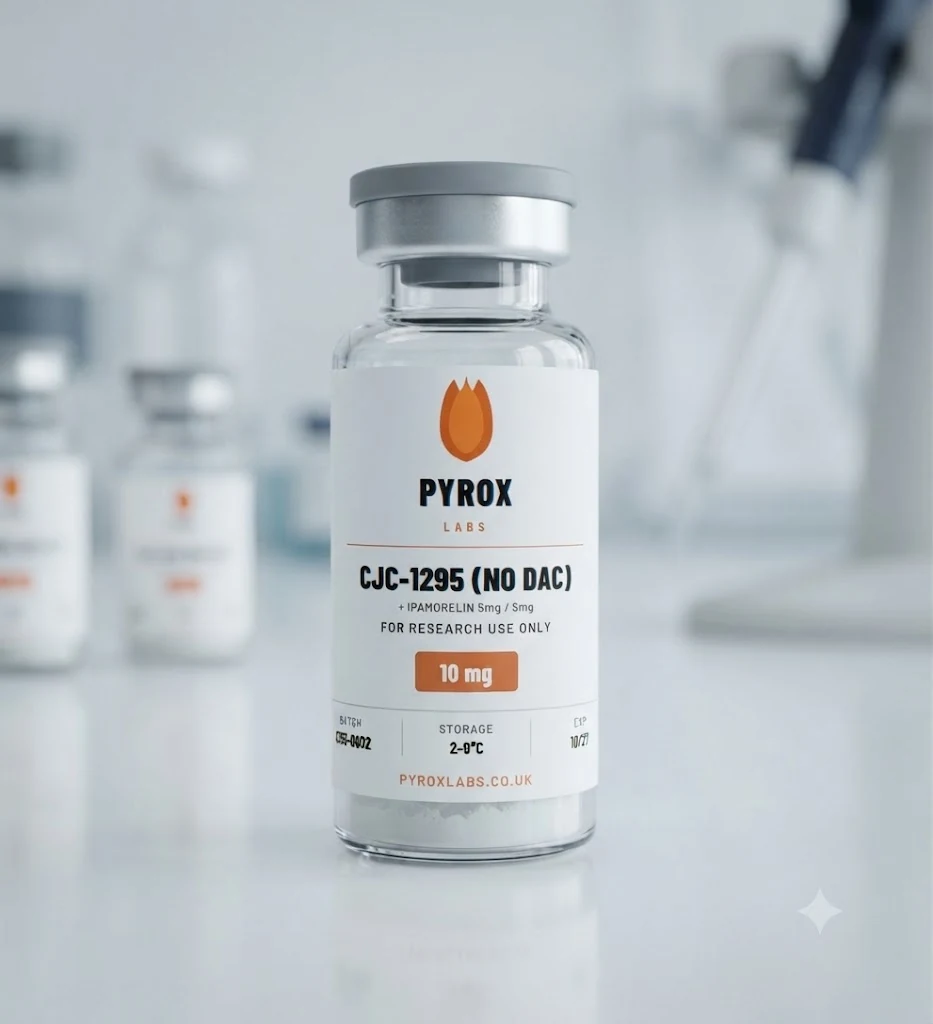
This CJC-1295 & Ipamorelin Research Guide is part of the Pyrox Labs Knowledge Hub — for laboratory and research use only. Not for human or veterinary use.
WHAT ARE CJC-1295 AND IPAMORELIN?
CJC-1295 is a synthetic growth hormone-releasing hormone (GHRH) analogue. Ipamorelin is a selective growth hormone secretagogue (a ghrelin receptor agonist). Both are studied in the context of the growth hormone/IGF-1 axis, and — because they act on different points of the same signalling pathway — they are frequently studied together in peptide research literature and commercial research contexts. This guide covers both compounds together, as they are supplied by Pyrox Labs as a combination research product, and summarises the published literature on each for laboratory researchers.
RESEARCH BACKGROUND
Published literature — see PubMed searches for CJC-1295 and ipamorelin — has explored areas including:
- Growth hormone and IGF-1 axis stimulation (CJC-1295): a 2006 randomised, placebo-controlled, double-blind human study found single-injection dose-dependent increases in plasma GH lasting six or more days, and IGF-1 increases lasting 9–11 days
- Receptor selectivity research (ipamorelin): its original 1998 characterisation established that, unlike earlier growth hormone-releasing peptides, ipamorelin stimulates GH release with minimal measurable effect on cortisol, prolactin, or ACTH
- Gastrointestinal motility research (ipamorelin): a Phase 2 randomised, double-blind, placebo-controlled human trial studied ipamorelin for postoperative ileus recovery following bowel surgery, with results suggesting accelerated return of bowel function
- Pharmacokinetic characterisation distinguishing the “No DAC” and “with DAC” forms of CJC-1295, which have substantially different half-lives
PROPOSED MECHANISM OF ACTION
CJC-1295 acts at the GHRH receptor on pituitary somatotroph cells, amplifying endogenous growth hormone pulses via the cAMP signalling pathway; structural modifications block the enzymatic cleavage sites that rapidly degrade native GHRH. Ipamorelin acts at the growth hormone secretagogue receptor (GHSR-1a) — the same receptor endogenous ghrelin activates — stimulating GH release while largely preserving the body’s natural pulsatile release pattern. Because GHRH analogues are studied for their effect on GH pulse frequency and ghrelin-receptor agonists are studied for pulse amplitude, the two mechanisms are considered complementary in the research literature. It is worth noting, however, that most specific quantified claims about combined effect (rather than the general mechanistic rationale) come from secondary or commercial sources rather than a peer-reviewed controlled combination trial.
HANDLING & STORAGE
- Store lyophilised vials in a freezer (-20°C), protected from light, for long-term storage.
- Once reconstituted, store refrigerated (2–8°C) and use within the timeframe indicated by your research protocol. Both peptides are short-chain and can be affected by vigorous agitation or repeated freeze-thaw cycles.
- Use sterile technique and appropriate PPE when handling.
- See our Reconstitution Guide for general laboratory reconstitution reference information.
CERTIFICATES OF ANALYSIS
Independently tested for purity and identity. Search by product name and the batch/lot number printed on your vial label.
FREQUENTLY ASKED QUESTIONS
Are CJC-1295 and Ipamorelin approved for human use?
No. These products are not approved by any regulatory authority for human or veterinary use. They are sold strictly for laboratory and research purposes.
Can Pyrox Labs advise on dosing or administration?
No. We do not provide dosing, administration, or treatment guidance of any kind. Our team can only answer questions relating to order status, product specifications, and COA/testing documentation.
What is the difference between CJC-1295 with DAC and without DAC?
The DAC (Drug Affinity Complex) modification enables the peptide to bind circulating albumin, extending its half-life to roughly 5–8 days versus a much shorter duration for the non-DAC form. Pyrox Labs’ combination product uses CJC-1295 (No DAC).
How is this product supplied for laboratory research?
Pyrox Labs supplies CJC-1295 (No DAC) and Ipamorelin as separate lyophilised (freeze-dried) powders within one combination research pack, with each batch accompanied by a Certificate of Analysis confirming purity and identity.
Research Use Disclaimer: CJC-1295 and Ipamorelin products sold by Pyrox Labs are intended solely for in-vitro laboratory research and are not for human consumption, veterinary use, or any form of personal use. By purchasing, you confirm you are a qualified researcher or institution and agree to our full Research Use Disclaimer and Terms & Conditions.
Related: Tesamorelin Research Guide · What Are Peptides · Reconstitution Guide · COA Hub