
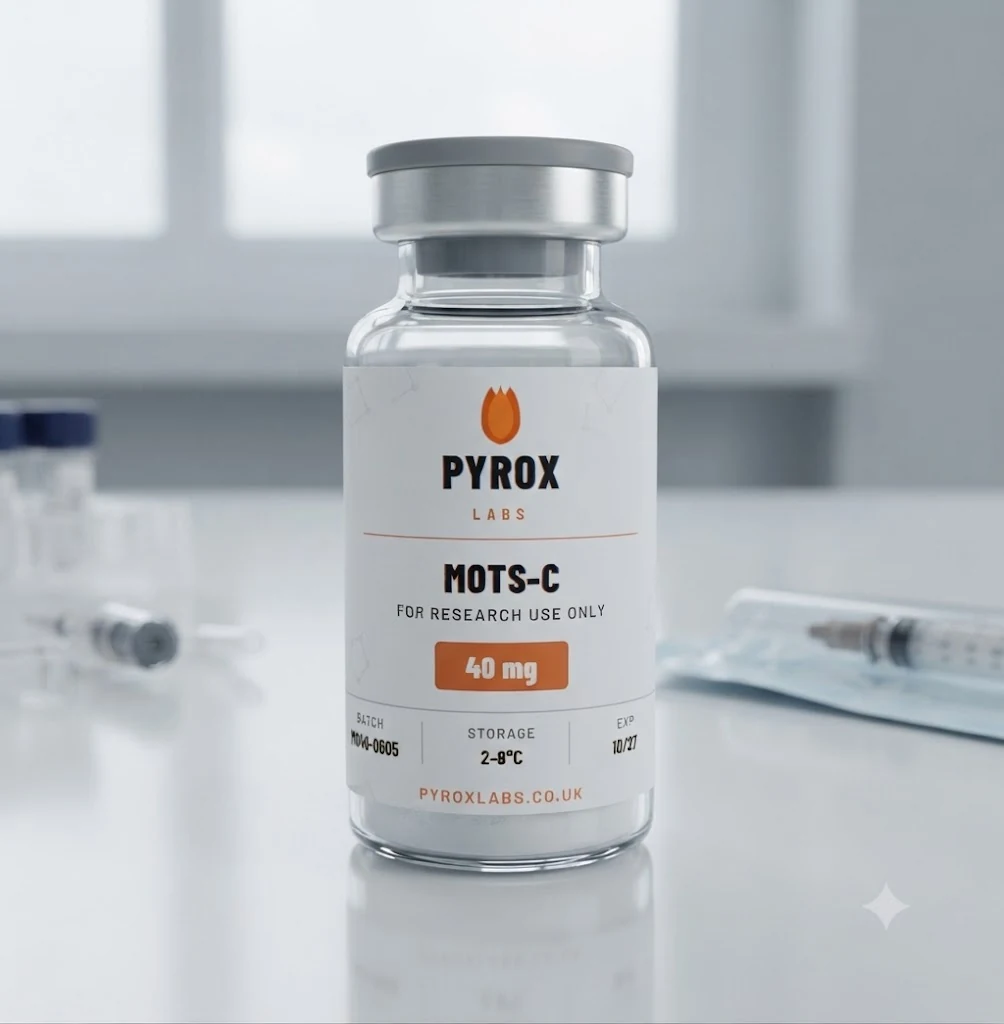
This MOTS-C Research Guide is part of the Pyrox Labs Knowledge Hub — for laboratory and research use only. Not for human or veterinary use.
WHAT IS MOTS-C?
MOTS-C is a 16-amino-acid mitochondrial-derived peptide (MDP) — encoded not by nuclear DNA but within the mitochondrial 12S rRNA gene. It functions as a “mitokine”: a mitochondria-to-cell, and even mitochondria-to-nucleus, signalling molecule. This distinguishes it mechanistically from the GH-axis and reproductive-axis peptides covered elsewhere in this Knowledge Hub. MOTS-C is studied primarily in metabolic and exercise-physiology research contexts. This guide summarises the published literature on MOTS-C for laboratory researchers.
RESEARCH BACKGROUND
Published literature — see this PubMed literature search — has explored areas including:
- The original 2015 discovery/characterisation study (Cell Metabolism), which found MOTS-C activated AMPK signalling in cell and mouse models and prevented high-fat-diet-induced weight gain and insulin resistance in mice
- Exercise physiology and age-related physical decline: a 2021 study (Nature Communications) found aged mice given MOTS-C ran approximately twice as long on a treadmill endurance test versus aged controls, and demonstrated that exercise itself induces endogenous MOTS-C expression in human skeletal muscle
- Nuclear gene-expression regulation: mechanistic work has shown MOTS-C translocates to the cell nucleus under metabolic stress to directly regulate gene expression, not just act as a cytoplasmic signal
- Metabolic homeostasis and insulin resistance research more broadly
Important for researchers: a Phase 2a human interventional trial investigating MOTS-C in adults with prediabetes/overweight-obesity was ongoing at time of writing, with results not yet reported. Beyond this in-progress trial, MOTS-C research is preclinical (animal and cell-model) — researchers should not treat MOTS-C as having established human efficacy data at this stage.
PROPOSED MECHANISM OF ACTION
MOTS-C is studied for its inhibition of the folate cycle and its linked de novo purine biosynthesis pathway, an effect associated with intracellular AICAR accumulation and subsequent activation of AMP-activated protein kinase (AMPK) — a central regulator of cellular energy metabolism. AMPK activation is linked to increased GLUT4 expression and glucose uptake in muscle tissue in preclinical models. Under cellular stress, MOTS-C has also been shown to translocate to the nucleus to regulate gene expression directly, producing a metabolic-reprogramming response researchers have described as resembling the physiological adaptations to exercise.
MOTS-C RESEARCH GUIDE — HANDLING & STORAGE
- Store lyophilised MOTS-C vials in a freezer (-20°C), protected from light, for long-term storage.
- Once reconstituted, refrigerate (2–8°C); published in-solution stability data indicates reconstituted MOTS-C can remain stable for at least 30 days under refrigeration, with methionine oxidation the primary degradation marker. Note this is distinct from its short biological half-life in circulation — aliquoting before freezing is recommended to avoid repeated freeze-thaw cycles.
- Use sterile technique and appropriate PPE when handling.
- See our Reconstitution Guide for general laboratory reconstitution reference information.
CERTIFICATES OF ANALYSIS
Independently tested for purity and identity. Search by product name and the batch/lot number printed on your vial label.
FREQUENTLY ASKED QUESTIONS
Is MOTS-C approved for human use?
No. MOTS-C products sold by Pyrox Labs are not approved by any regulatory authority for human or veterinary use. They are sold strictly for laboratory and research purposes.
Can Pyrox Labs advise on dosing or administration?
No. We do not provide dosing, administration, or treatment guidance of any kind. Our team can only answer questions relating to order status, product specifications, and COA/testing documentation.
Has MOTS-C been tested in humans?
Published, completed interventional human trial data is not yet available. A Phase 2a human trial in prediabetes/overweight-obesity was ongoing at time of writing; results were not yet reported. Current evidence is predominantly preclinical.
How is MOTS-C supplied for laboratory research?
Pyrox Labs supplies MOTS-C as a lyophilised (freeze-dried) powder in a sealed research vial, accompanied by a Certificate of Analysis confirming purity and identity.
Research Use Disclaimer: MOTS-C products sold by Pyrox Labs are intended solely for in-vitro laboratory research and are not for human consumption, veterinary use, or any form of personal use. By purchasing, you confirm you are a qualified researcher or institution and agree to our full Research Use Disclaimer and Terms & Conditions.
Related: SS-31 (Elamipretide) Research Guide · NAD+ Research Guide · Reconstitution Guide · COA Hub