
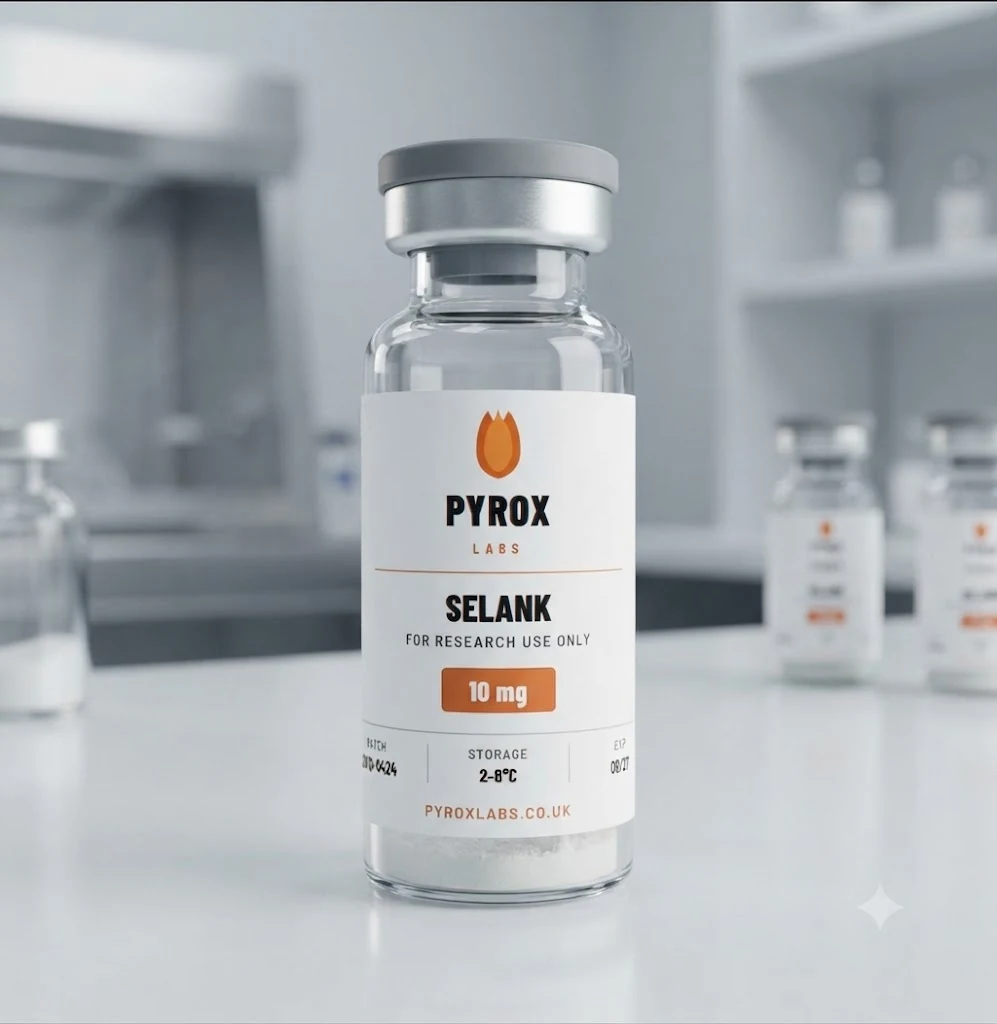
This Selank Research Guide is part of the Pyrox Labs Knowledge Hub — for laboratory and research use only. Not for human or veterinary use.
WHAT IS SELANK?
Selank is a synthetic heptapeptide, an analogue of tuftsin (a naturally occurring immunomodulatory peptide fragment of IgG), developed at the Institute of Molecular Genetics, Russian Academy of Sciences. It belongs to the “glyproline” family of peptides — compounds bearing a stabilising Pro-Gly-Pro motif — and is classed functionally as an anxiolytic/nootropic research peptide. This guide summarises the published literature on Selank for laboratory researchers.
RESEARCH BACKGROUND
Published literature — see this PubMed literature search — has explored areas including:
- Anxiolytic research: a published human study (62 participants with generalised anxiety disorder/neurasthenia) compared intranasal Selank against a benzodiazepine over 14 days, reporting comparable anxiolytic effect without sedation or psychomotor impairment
- Rodent behavioural research, including studies where Selank was found to potentiate the anxiolytic effect of diazepam in chronic-stress models
- Antiviral/immunomodulatory research: in vitro and mouse influenza models associated with induction of interferon-alpha gene expression
- Gene-expression studies examining GABAergic neurotransmission pathways
A note on the evidence base: the human clinical study cited above is real and PubMed-indexed, but it is small and has not been independently replicated outside Russia. Nearly all of Selank’s foundational pharmacology originates from a small number of Russian research groups. Researchers should weigh this provenance when assessing the overall strength of evidence.
PROPOSED MECHANISM OF ACTION
No single high-affinity receptor for Selank has been definitively established in the literature. Proposed mechanisms include inhibition of enkephalin-degrading aminopeptidase enzymes (raising endogenous enkephalin tone), modulation of GABA-A receptor subunit expression, and effects on serotonin turnover observed in rodent brain-region studies. These mechanisms remain active areas of investigation rather than settled pharmacology.
SELANK RESEARCH GUIDE — HANDLING & STORAGE
- Store lyophilised Selank vials in a freezer (-20°C), protected from light, for long-term storage.
- Once reconstituted, store refrigerated (2–8°C) and use promptly, following the timeframe indicated by your research protocol — as a short peptide, precise validated stability data is limited, so conservative handling is advised.
- Use sterile technique and appropriate PPE when handling.
- See our Reconstitution Guide for general laboratory reconstitution reference information.
CERTIFICATES OF ANALYSIS
Independently tested for purity and identity. Search by product name and the batch/lot number printed on your vial label.
FREQUENTLY ASKED QUESTIONS
Is Selank approved for human use?
No. Selank products sold by Pyrox Labs are not approved by any regulatory authority for human or veterinary use. They are sold strictly for laboratory and research purposes.
Can Pyrox Labs advise on dosing or administration?
No. We do not provide dosing, administration, or treatment guidance of any kind. Our team can only answer questions relating to order status, product specifications, and COA/testing documentation.
Is Selank the same as Semax?
No, though the two are often discussed together as related Russian-developed glyproline peptides from the same research institute. Selank is a tuftsin analogue; Semax is an ACTH(4–10) analogue. They are structurally and mechanistically distinct — see our Semax Research Guide.
How is Selank supplied for laboratory research?
Pyrox Labs supplies Selank as a lyophilised (freeze-dried) powder in a sealed research vial, accompanied by a Certificate of Analysis confirming purity and identity.
Research Use Disclaimer: Selank products sold by Pyrox Labs are intended solely for in-vitro laboratory research and are not for human consumption, veterinary use, or any form of personal use. By purchasing, you confirm you are a qualified researcher or institution and agree to our full Research Use Disclaimer and Terms & Conditions.
Related: Semax Research Guide · DSIP Research Guide · Reconstitution Guide · COA Hub